
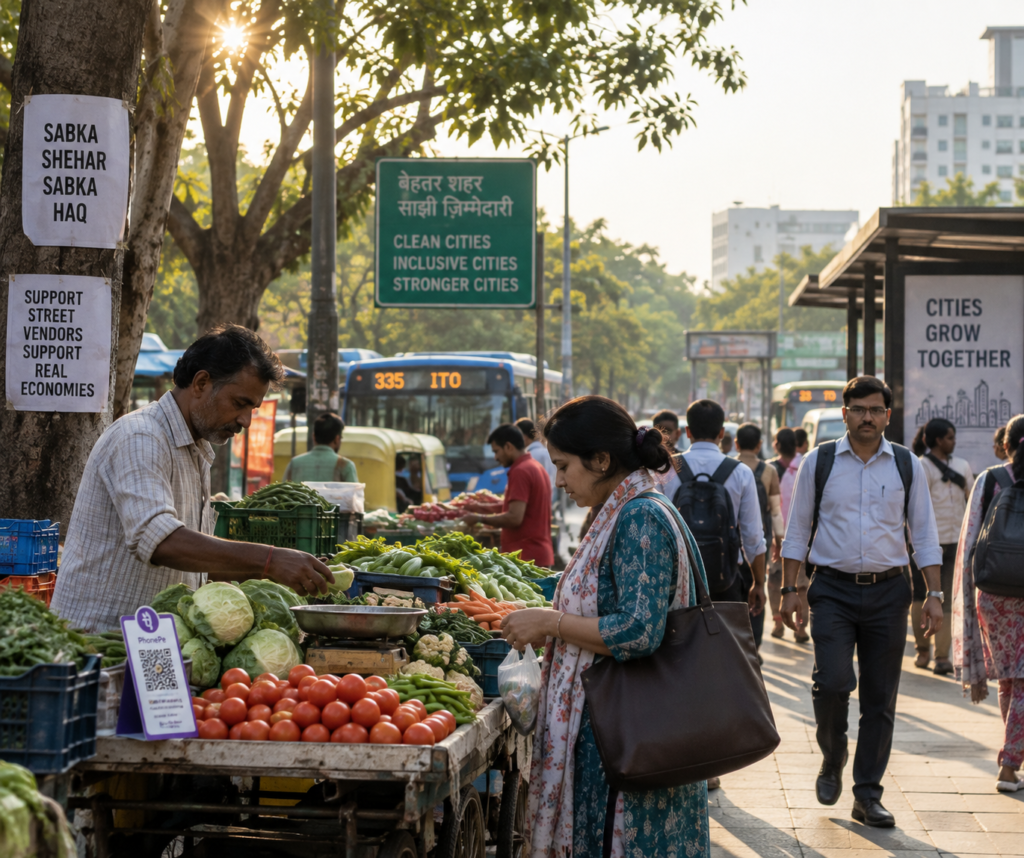
Source: GenAI
Ankit Kumar Pathak is a Management student at Chandigarh University, Punjab, India, and the Founder of TheOne Wealth.
Every Indian city has a familiar street economy. Vegetable sellers begin work before sunrise, tea vendors serve commuters, fruit sellers operate near markets, and small food stalls serve workers and students every day. These businesses may not operate from conventional shops, but they are an important part of urban economic life. Street vending is therefore not simply a question of occupying public space. It involves livelihood, financial inclusion, urban planning and the right to participate in the city’s economy. India recognised this through the Street Vendors (Protection of Livelihood and Regulation of Street Vending) Act, 2014, which provides a legal framework to protect street vendors while regulating vending activities. The challenge today is ensuring that these protections work effectively on the ground.
PM SVANidhi: Supporting Small Urban Businesses
The PM Street Vendor’s AtmaNirbhar Nidhi (PM SVANidhi) scheme was launched in June 2020 to provide working-capital support to street vendors whose businesses were affected by the COVID-19 pandemic. The scheme has since evolved into a broader financial inclusion programme. Under its restructured framework, eligible vendors can access collateral-free loans of ₹15,000, ₹25,000 and ₹50,000 through successive tranches, linked to repayment of earlier loans. The scheme also provides interest subsidies, credit-guarantee support and incentives for digital payments. Eligible vendors can also receive a UPI-linked RuPay credit card with a limit of up to ₹30,000. According to government data, by July 2026, PM SVANidhi had supported millions of vendors through more than one crore loans. The scheme has therefore become an important bridge between informal businesses and the formal financial system.
However, access to credit alone cannot solve every problem faced by street vendors. A Loan Cannot replace a Secure Workplace. A vendor may receive working capital, purchase better equipment and accept digital payments, but the business can remain vulnerable without a predictable place to operate. The Street Vendors Act, 2014, provides for surveys of street vendors, vending certificates, vending zones, and Town Vending Committees. It also establishes procedures concerning relocation and eviction. This creates an important distinction between regulation and exclusion. Cities have legitimate responsibilities. Roads must remain accessible, footpaths need to be usable, public spaces require sanitation, and emergency services must have adequate access. Residents also expect clean and safe surroundings.
At the same time, regulations should consider the economic reality of vending. A vendor relocated far from the original customer base may technically receive another location, but the business may become commercially unsustainable. For a small vendor whose income depends on daily sales, location is an economic asset. Therefore, urban authorities need to consider both public-space management and livelihood security when designing vending policies. The Implementation Gap: India has a national legal framework, but street vending is experienced primarily at the municipal level.
Local authorities play an important role in implementing vending regulations. This makes transparency and predictable procedures essential. Vendors should know where they can legally operate, what permissions they require, what fees apply and what rules they must follow. They should also have access to effective grievance-redressal mechanisms when disputes arise. At the same time, residents should understand how vending zones are planned and how issues such as congestion, waste management and pedestrian safety are being addressed. A transparent system benefits both sides. Clear rules make enforcement easier while reducing uncertainty for vendors.
Digital Payments: A New Opportunity
Digital payments have also changed the street-vending economy. UPI allows small vendors to accept payments without maintaining traditional card-payment infrastructure. PM SVANidhi encourages digital transactions through incentives and has incorporated digital financial products into its expanded framework. Government data has reported substantial adoption of digital payments among PM SVANidhi beneficiaries.
Digital payments can provide convenience and help small businesses build a financial transaction history. But digitalisation should not be considered a complete form of financial inclusion. A QR code cannot, by itself, provide insurance, retirement security, business training, or protection against displacement. The next stage of policy should therefore combine digital access with financial literacy, social security and enterprise development. Urban Planning Must Include Vendors
The debate over street vending is ultimately a debate about how public space is organised. Instead of treating vendors only as obstacles to urban development, cities can incorporate vending into their planning systems. Properly designed vending zones, waste-disposal facilities, water access, sanitation, pedestrian planning, and clearly defined operating hours can create an organised environment. This approach does not mean permitting vending everywhere. It means creating a system in which vending is regulated, planned and integrated into urban development. Street vendors also provide affordable and accessible goods and services close to residential areas, workplaces and transport hubs. Their contribution to everyday urban life should therefore be taken into account when cities plan their commercial spaces.
From Credit to Sustainable Livelihoods
PM SVANidhi has increasingly moved beyond emergency financial assistance toward longer-term financial inclusion. The scheme has been extended until 31 March 2030, with an overall outlay of ₹7,332 crore and a target of benefiting 1.15 crore street vendors, including 50 lakh new beneficiaries. The next challenge is connecting financial assistance with broader opportunities. Street vendors need access to credit, skills, digital literacy, market information, social-security programmes, sanitation facilities and secure vending spaces. The SVANidhi se Samriddhi component also seeks to connect beneficiaries and their families with various welfare schemes, reflecting a broader approach to improving household economic security. This matters because a street vendor is not simply a beneficiary of a government scheme. The vendor is also a worker and a small entrepreneur, contributing to the urban economy.
The future of Indian urbanisation should not be presented as a choice between modern cities and street vendors. A modern city can have efficient roads, clean public spaces and regulated vending. It can use digital technology while protecting livelihoods. It can enforce sanitation and safety standards without making economic vulnerability a reason for exclusion. The Street Vendors Act provides a legal framework, PM SVANidhi provides financial support, and digital payments create new opportunities. The remaining challenge is effective implementation at the local level.
References
(2020). India: Online Dashboard of PM SVANidhi launched. MENA Report, (),.
Disclaimer: The views expressed in this article are strictly the author’s own and do not represent the views of the publisher.