
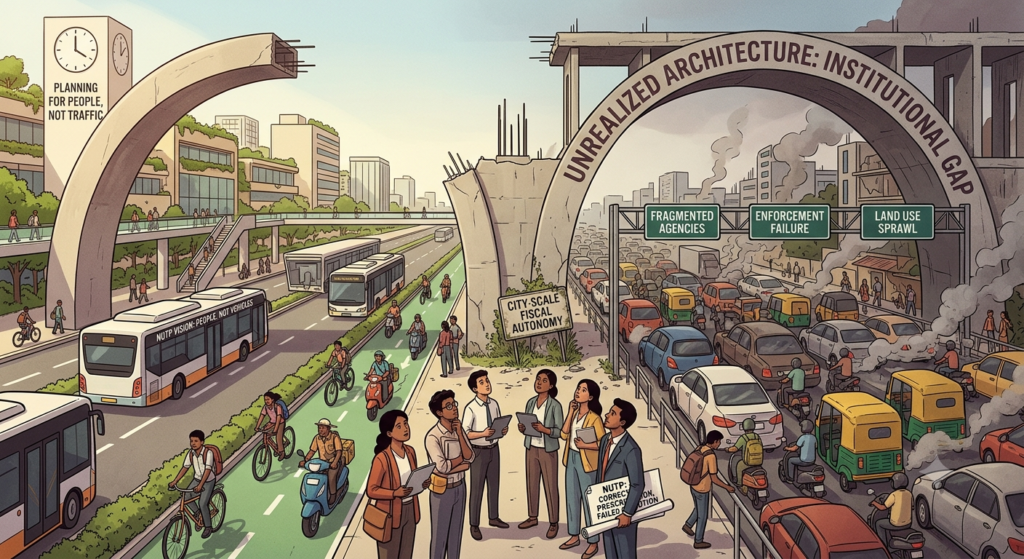
Every morning, millions of Indians lose hours they’ll never get back stuck in traffic on roads that were never built with people in mind. In 2006, India’s National Urban Transport Policy diagnosed exactly why, and proposed a genuinely radical fix: reallocate road space from vehicles to people, fund cities through the land they sit on, and force fragmented agencies to coordinate under one roof. Two decades later, most of that architecture still exists only on paper. This piece asks the uncomfortable question every policy student eventually has to ask not whether the diagnosis was right, but why India keeps writing the correct prescription and failing to fill it.
Beyond the Vision Statement: Revisiting India’s National Urban Transport Policy
The urbanization process in India is one that few of its institutions were designed to handle. The National Urban Transport Policy (NUTP) was drafted when the urban population was estimated to grow from about 285 million in 2001 to almost 820 million by 2051, a near threefold increase that would strain the capacity of all municipal corporations, transport authorities, and land-use plans in the country. Read today, and with two decades of patchy urban governance reform, the NUTP is more of an argument that has been settled than a finished product one whose arguments remain valid, even if its instruments have been fragile.
A People-Centered Vision, Framed Through a Federal Anomaly
The policy’s vision is well stated: to shift the focus of urban mobility planning away from vehicles and towards people, and to enable cities to “evolve into an urban form that is best suited for the unique geography of their locations. This is a sound planning approach. However, it does not fit into the constitutional structure of India. Urban transport, as urban governance in general, is a State and municipal subject under the Seventh Schedule, which is implemented (to a lesser extent) through the devolution of the subject to Urban Local Bodies under the 74th Constitutional Amendment. The NUTP’s own rationale for a national policy is significant: it cites the lack of accountability between the Centrally controlled transport agencies and the State governments, and several Central Acts that directly impact urban transport, as reasons for Delhi to intervene. The policy, in essence, admits a failure of coordination that the 74th Amendment was meant to address but failed to do so. This is the major unresolved conflict in urban governance in India today, 20 years after the use of Central financial leverage instead of real fiscal and functional autonomy of the cities, not to mention the latter.
The Land Use–Transport Integration Problem
One of the NUTP’s more sophisticated observations is that transport planning has not been given the level of attention it deserves in the preparation of strategic development and land use plans that cities have tended to develop infrastructure after the fact of sprawl, rather than to plan for growth along corridors. The proposed remedy in the policy, which is to have in-house transport planners in urban development authorities and provide 50% Central funding for integrated land-use–transport plans, is conceptually correct. However, it relies entirely on the capacity of most State Town and Country Planning Departments and Development Authorities that they did not have in 2006, and in many second-tier cities, arguably still do not. A funding formula is not a replacement for a viable planning bureaucracy. A common failure mode in Indian urban reform is the policy instrument designed with technocratic elegance but assuming a level of institutional competence that decades of understaffed, under-resourced municipal planning departments cannot provide.
Persuading the public to accept the use of road space for equity is a difficult challenge.
The NUTP’s section on the allocation of road space is perhaps the most quietly radical. It notes that a bus with 40 passengers uses only about two-and-a-half times the road space of a car with one or two passengers, and that this “distributive injustice” is most severely felt by lower-income commuters and non-motorized transport users, who are “squeezed out” by unsafe shared right-of-way arrangements. The proposed correctives – separate bus and non-motorized transport lanes, High Occupancy Vehicle lanes, and changes to the Motor Vehicles Act to ensure stricter enforcement – are well targeted. The policy admits the failure of its own mechanism, however: “Experience has shown that motorists do not use such reserved lanes. A policy that defines enforcement failure as the main problem and then enforcement as the solution is likely to be circular. Real road space equity would entail political costs that Central guidelines can’t legislate at the municipal level: the costs of reallocating space away from private vehicle owners, who are also disproportionately the electorally influential.
The SPV Model and Viability Gap Funding.
On finance, the NUTP expects to see instruments that will become commonplace in the Indian infrastructure policy: Special Purpose Vehicles, viability gap funding capped at 20% of capital cost, betterment levies on land value uplift along transit corridors, and public-private partnerships for project development. This has since evolved into value-capture financing discussions for metro rail projects across the country. However, the policy’s funding principle, “government should provide the infrastructure, but the users… must pay for the operating costs and the rolling stock,” has been politically challenging. Fare revision is one of the most contentious issues in the governance of public transport in India, and most State Transport Undertakings (STUs) are still incurring significant losses, even as the NUTP had hoped to prevent this by dividing services into “basic” and “premium” categories.
The Institutional Gap: UMTAs as Unrealized Architecture
The most significant recommendation, and the least implemented, of the policy is the establishment of Unified Metropolitan Transport Authorities (UMTAs) in all the million-plus cities, to coordinate planning across the disparate agencies that usually manage urban transport (municipal corporations, development authorities, traffic police, State transport undertakings, and parastatal metro corporations). Twenty years on, UMTAs are still in place in very few cities, often with little statutory power as the NUTP had hoped, and seldom with any real power over the agencies they are supposed to coordinate. This is the most obvious example of a larger trend in Indian urban policy: the prescription of a new coordinating institution is often right, but the prescription of a new coordinating institution on top of an already crowded institutional landscape is not necessarily the right one, as it does not change the incentives of the institutions it is supposed to coordinate.
Conclusion
The NUTP’s enduring impact is not so much in the administrative results it produced as in the conceptual language it offered for the governance of Indian urban transport – equitable road space, integrated land-use planning, differentiated service quality, land-based value capture. Its flaws are the same as those of Indian urban policy: that a good policy is a good policy, and that the institutional ability to implement it exists when it doesn’t. The limitations of its own are the limitations of the federal question in India, either because the cities have not been given the fiscal and functional autonomy that the Constitution intended, or because they have been the recipients of a succession of centrally sponsored planning exercises. The policy is most valuable for students of urban governance not as a blueprint, but as a diagnostic document, one that was able to identify the right problems even if the solutions it offered needed institutional follow-through, and still do.
Source: Ministry of Urban Development. (2014). National urban transport policy. Government of India.
Disclaimer: The views expressed in this article are strictly the author’s own and do not represent the views of the publisher.