
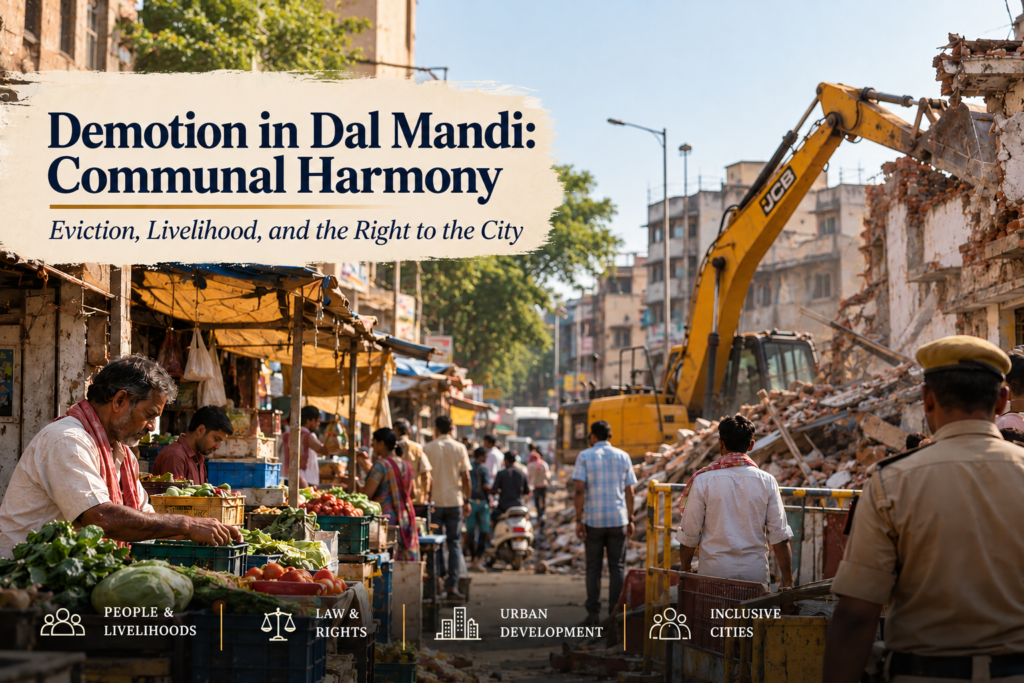
Eviction, Livelihood, and the Right to the City
Cities are not built only with concrete, roads, and buildings. They are also built through the everyday activities of the people who live and work in them. Street vendors are an important part of this urban life. They provide affordable food, goods, and services while creating livelihoods with relatively little capital. However, when cities attempt to modernise, beautify, or regulate public spaces, street vendors often become the first to face eviction, relocation, or demolition.
This raises an important question: Whose cities are these, and whose streets are they?
The issue is not simply a conflict between development and street vending. It is a question of how urban development can proceed while respecting livelihoods, dignity, public safety, and the rights of people who depend on the streets for their income.
Eviction Drives vs. Livelihood Rights
Street vending is often treated as an obstruction to traffic, sanitation, or urban planning. Concerns about congestion, hygiene, theft, security, and public safety can be genuine and require regulation. Poorly managed vending areas may also contribute to difficulties related to waste management and the quality of public spaces.
However, eviction without adequate planning can create another set of problems. When vendors lose their workplace, they may lose their primary source of income. Relocation to distant or unsuitable areas can reduce their customers and increase their operating costs. For people working with little or very little capital, even a small disruption can have significant consequences. Therefore, urban policy needs to consider both sides: the public interest in organised streets and the livelihood interests of street vendors.
The Case of Dal Mandi
Dal Mandi can be viewed as an example of how questions of demolition, displacement, and urban development intersect with the social and economic life of a neighbourhood. Any demolition or redevelopment in such an area should not be examined only in terms of the number of structures removed. Its wider effects need to be considered—how many homes and business premises are affected, how many people are displaced, what happens to their livelihoods, and whether adequate rehabilitation or restoration is provided. The social character of a locality can also change when long-established businesses and communities are displaced. Thus, demolition can have consequences extending beyond physical structures.
Demolition and Its Human Impact
The character of demolition should be assessed through several factors:
- Its effect on livelihoods
- Whether the demolition has a valid legal basis
- Whether due process has been followed
- Whether the demolition is lawful or unlawful
- The number of houses and business premises affected
- The number of people displaced
- Availability of rehabilitation or alternative arrangements
- Efficiency of the administrative machinery
- Compliance with rules and regulations governing demolition
These questions are important because a city cannot measure the success of redevelopment only by the space it clears. It must also consider what happens to the people who occupied that space.
Law, Regulation, and the Rights of Street Vendors
India’s legal framework recognises that street vending requires both regulation and protection. The Street Vendors (Protection of Livelihood and Regulation of Street Vending) Act, 2014, was enacted to protect the rights of urban street vendors and regulate street vending. The Act provides for surveys of street vendors; protection from eviction or relocation, subject to its provisions; certificates of vending; relocation procedures; and mechanisms for grievance redressal. The legal history of street vending also includes the Supreme Court’s 1985 decision in Bombay Hawkers’ Union v. Bombay Municipal Corporation, which dealt with the right of hawkers to carry on their trade and the regulation of hawking through licensing and designated zones. These developments show that the debate is not simply about whether vending should exist on city streets. The larger question is how vending can be regulated without unnecessarily destroying livelihoods.
Certificate of Vending and Relocation
A significant aspect of the 2014 Act is the formal recognition of street vendors through mechanisms such as the vending certificate. The law also addresses relocation and eviction and provides a framework for resolving grievances. This approach seeks to move away from an informal system in which vendors can be removed without a predictable regulatory framework. At the same time, regulation remains necessary to address public hygiene, civic amenities, and the orderly use of public spaces. The challenge, therefore, is to create a balance between rights and responsibilities.
Streets and Communal Harmony
Streets are more than transportation spaces. They are places where different communities interact, trade, and build social relationships. Markets and neighbourhoods can develop their own social and economic identities over decades. Sudden displacement can therefore affect not only individual livelihoods but also the social fabric of an area. In places such as Dal Mandi, questions surrounding demolition should consequently be considered in terms of livelihood, displacement, social relationships, and communal harmony, alongside legitimate concerns about urban planning and public infrastructure.
Towards Inclusive Cities
A modern city need not choose between development and livelihoods. Better planning can create designated vending zones, improve sanitation and waste management, regulate traffic, maintain pedestrian access, and provide vendors with secure and clearly defined spaces. At the same time, authorities should ensure that relocation or eviction follows the applicable legal procedures and that affected people have access to appropriate remedies and, where required, rehabilitation or alternative vending arrangements. The 2014 Act itself establishes a framework for regulating vending while recognising vendors’ rights.
Conclusion
The streets of a city belong to its public life, and that public life includes the people who earn their livelihoods on those streets. Development, cleanliness, security, and efficient urban planning are important, but so are livelihood and dignity. The real challenge is therefore not simply to clear the streets, but to plan them better. A city truly becomes inclusive when its policies make space for both urban development and the people whose everyday work keeps the city alive. “Streets keep our cities alive; therefore, the people who make those streets function must not become invisible in the process of development.”
References
Cases and Legal Analysis | Centre For Civil Society. https://old.ccs.in/livelihood/cases-and-legal-analysis
Jayaraman, M., & Mani, G. N. (2026). Vulnerability and Policy Gaps among Fruit and Vegetable Street Vendors in Tiruchirappalli Taluk: A Case Study. International Journal For Multidisciplinary Research. https://doi.org/10.36948/ijfmr.2026.v08i02.70544
Shriya Sahwal is a graduate student of the Bachelor of Vocation in Modern Office Management at Banaras Hindu University (RGSC, BHU)
Disclaimer: The views expressed in this article are strictly the author’s own and do not represent the views of the publisher.