
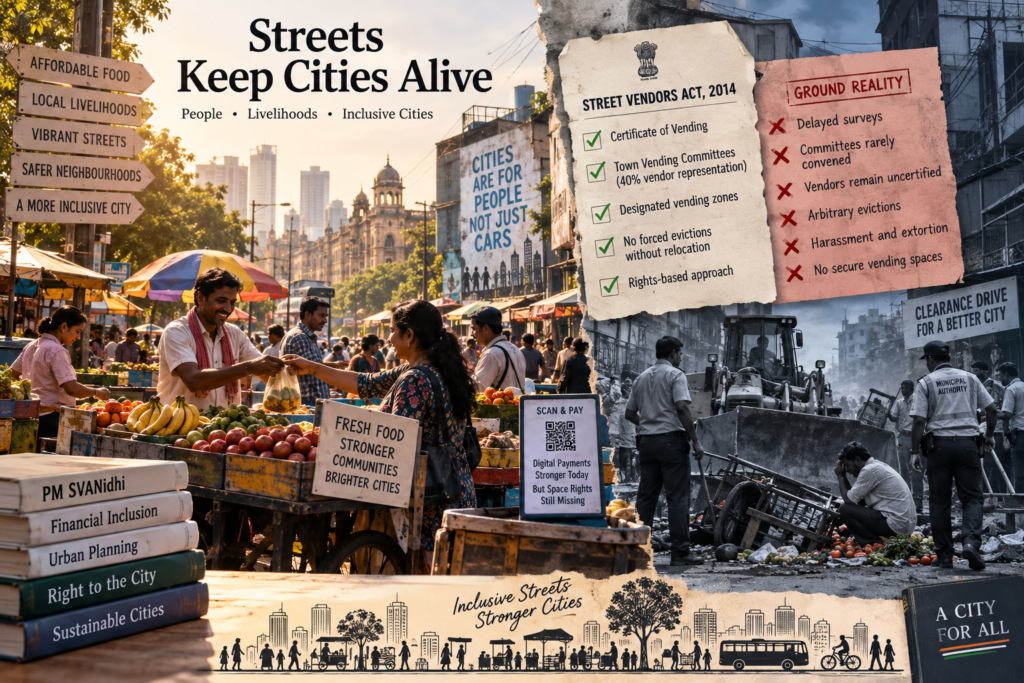
Image source: GenAI
Anshika Upadhyay is a Student and Researcher pursuing an MBA with specialisations in Financial Reporting & Analysis and Marketing Management at Chandigarh University, Punjab, India.
Walk down any major street in an Indian metropolis, and you do not judge its energy by glass towers or landscaped public parks. You feel it through the fruit sellers calling out, the aroma of corner food carts, and rows of vibrant pushcarts lining busy pavements. Street vendors are the true circulatory system of the urban informal economy. They keep neighbourhoods supplied with affordable, fresh food, create micro-entrepreneurship opportunities, and act as Jane Jacobs’ conceptual “eyes on the street,” making public thoroughfares safer and more vibrant.
Yet despite keeping urban life moving, street vendors exist in a state of perpetual legal and economic uncertainty. Indian city planning relies on them daily, but local policy frameworks continuously marginalise them as illegal occupiers of space.
The Economic Engine on the Pavement
Street vending in India is far more than a marginal survival tactic; it is a vital economic engine. Estimates indicate that vendors make up roughly 2.5% of the total population in major cities. They form a crucial link in supply chains, bridging the gap between rural agricultural producers and urban consumers. For lower- and middle-income families, informal markets offer a low-cost lifeline for daily nutrition and household essentials.Beyond economics, vending humanises the built environment. In an era where modern urban design increasingly favours gated communities and privatised public spaces, vendors preserve the street as a shared, democratic resource. They foster social interaction, build neighbourhood ties, and ensure public thoroughfares remain active across all hours.
Legislative Promise vs. Administrative Failure
The legal framework to safeguard these livelihoods exists on paper. The landmark Street Vendors (Protection of Livelihood and Regulation of Street Vending) Act of 2014 was intended to establish a rights-based regime. The Act mandated Town Vending Committees (TVCs) with vendor representation, called for spatial surveys to issue Certificates of Vending, and explicitly prohibited forced evictions without relocation. However, a massive gap remains between legislative intent and ground reality. A decade after its enactment, enforcement remains fragmented and deeply flawed:
a) Delayed Surveys: Municipal authorities routinely delay comprehensive mapping, leaving hundreds of thousands of vendors without formal legal recognition. b) Disempowered Governance: Town Vending Committees are mandated to include 40% vendor seats, but these seats are rarely convened or remain dominated by municipal officials. c) Arbitrary Evictions: Clearance drives conducted under the guise of “beautification” or traffic decongestion routinely ignore mandatory relocation protocols. d) Rent-Seeking Extortion: Without certificates, vendors face constant harassment, illegal confiscations, and extortion by local authorities.
Policy Mandate vs. Ground Reality
Legal Identity: The law mandates issuing official Certificates of Vending through comprehensive surveys, but delayed counts leave most vendors uncertified and vulnerable to extortion. Governance: The law requires Town Vending Committees to include 40% vendor representation, but the committees are rarely convened, and municipal officials dominate decision-making.
Spatial Rights: The law requires designating clear vending zones, but cities prioritise vehicular parking and road widening, treating vendors as illegal encroachments.
Relocation: The law strictly prohibits forced evictions without notice and relocation, but authorities routinely conduct sudden clearance drives and confiscate goods.
Financial Inclusion Without Spatial Rights
In response to the economic shock of the COVID-19 pandemic, the government launched the PM SVANidhi scheme to offer micro-credit loans to vendors. The initiative accelerated digital payment adoption, such as QR codes on pushcarts. While digital transactions have skyrocketed, financial inclusion alone does not guarantee spatial rights. A vendor may process transactions via direct bank transfer while still operating under the daily threat of an illegal municipal crackdown. Having a QR code stand on a cart does not stop authorities from confiscating it. Credit access cannot substitute for the foundational right to a secure physical space to sell.
Reclaiming the Right to the Urban Commons
At its heart, the crisis facing street vendors is a debate over who the city belongs to. Current municipal planning paradigms heavily privilege motorised transport, retail conglomerates, and aesthetic gentrification, framing vendors as “traffic hazards” or “eyesores”. This perspective fundamentally misinterprets urban space. The concept of the “Right to the City” demands that urban infrastructure prioritise equity, inclusion, and the livelihoods of all citizens. Integrating vendors into city master plans requires treating street vending not as an encroachment to be cleared, but as an essential public utility to be managed.
Strategic Recommendations
a) Empower Vendor Committees: Transfer actual spatial mapping authority directly to Town Vending Committees, ensuring vendor representatives hold active voting power over zoning proposals. b) Design Inclusive Streets: Update municipal road engineering standards to integrate permanent vending stalls, utility connections, and waste disposal units directly into street cross-sections. c) Enforce Administrative Accountability: Establish statutory Grievance Redressal Committees to impose financial and administrative penalties on municipal officers executing unauthorised evictions. d) Integrate Master Planning with Vending Registries: Connect PM SVANidhi credit databases with urban master planning tools so financial profiles automatically translate to spatial registration and legal protection. e) Streets do not exist merely to move vehicles; they are public spaces meant to sustain human life. Protecting the rights of street vendors is not an act of charity, but a prerequisite for building sustainable, equitable, and resilient cities.
References-
October 2022 Market & Economic Recap – One Wealth MGMT. https://onewealthmgmt.com/october-2022-market-economic-recap/
Disclaimer: The views expressed in this article are strictly the author’s own and do not represent the views of the publisher.
.