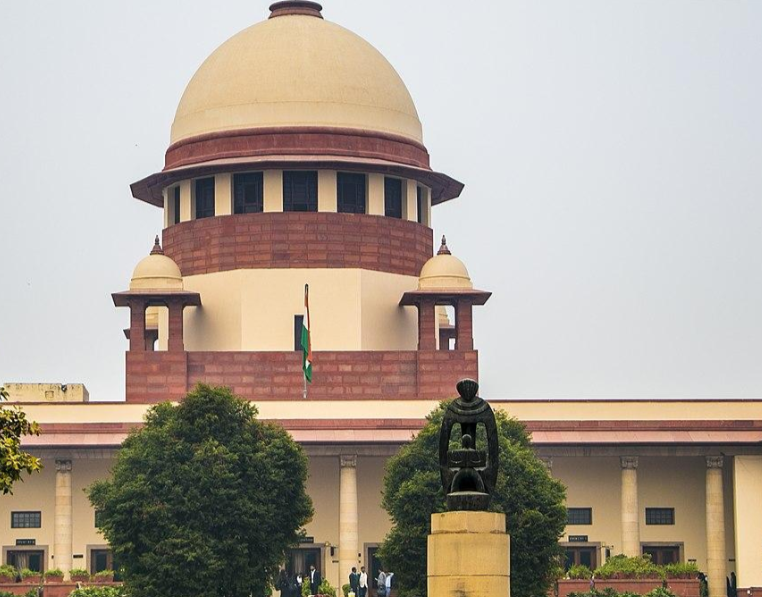
Photo: Pinakpani, Building of The Supreme Court of India, Wikimedia Commons, CC BY-SA 4.0.
The Supreme court of India functions as a guardian of our Indian Constitution and when necessary interprets the provisions as per the situations where the Constitution is silent. The tussle between the judiciary and the legislature is not new and doesn’t revolves around a single issue but many, Article 368 is one such issue which had, since the very inception of the Constitution, remained a bone of contention between these two institutions. This is not just a tussle between the Judiciary and the Legislature, it’s a tussle between the Power to amend and the power to interpret and guard, between the changing force and the conservative force. And the tussle consequently resulted in many of the constitutional developments primarily by maintaining a balance between the two poles. The story begins from the very First year of Commencement of Constitution of India in Shankari Prasad VS. Union of India, where the Constitutionality of first constitutional amendment which inserted Articles 31-A and 31-B and the 9th schedule, initially containing 13 agrarian reform laws, a debate started in the courtrooms that whether Constitutional amendment is a law or not and can parliament amend any provision, including fundamental rights?
Initially as the Supreme court at that time was going on the principle of ‘Literal interpretation’ said that yes Parliament can amend Fundamental Rights and Constitutional amendment is not ‘law’ under Article 13(3)(a) which means it can be violative of Fundamental rights. The same was confirmed in Sajjan Singh vs. State of Rajasthan case where Justice Gajendragadkar explicitly said that, “ If the Constitution makers intended to exclude the fundamental rights from the scope of amending power they would have made a clear provision in that behalf”. But in a very interesting twist In I.C. Golaknath vs. State of Punjab the court changed its track completely because it understood that if unlimited amending powers were given in the hands of legislature then they are ready to create a new constitution of their own choice which will only fulfill their political goals not the welfare of the common public, and that is why, in the Historic Keshavananda Bharati vs. State of Kerala the court developed a balancing approach and said that though the parliament has power to amend any provision in the constitution including the Fundamental rights but this amending power is not absolute and thus propounded the ‘Basic Structure Doctrine’.
The story takes a turn here and a new question arises that what is the Basic structure? The answer lies that something which is very much Fundamental to the spirit of the Constitution. That there are implied limitations on the power of amendment under article 368, because of ‘Something which the constitution makers imagined that it would never be deleted from the Constitution’. Delivering the majority opinion in Keshavananda Bharati Judgement, the then Chief Justice S.M. Sikri said that, “The concept of amendment within the contours of the Preamble and the Constitution cannot be said to be a vague and unsatisfactory idea which parliamentarians and the public would not be able to understand. He said that the argument that because something cannot be cut
and dried or nicely weighed or measured and therefore doesn’t exist is fallacious. There are many concepts of law which are not capable of exact definition, but it does not mean that it does not exist. The true position is that every provision of the Constitution can be amended provided in the result the basic foundation and structure of the constitution remains the same”. The supreme court on time to time have told that what is the Basic Structure and what not in an illustrative form which is not exhaustive and from here the problem of vagueness starts.
No one knows what is exactly the basic structure, not even the organ which is designated with the task of amending the Constitution, so that it could have this thing in its mind, not to violate the same. Critics argue that it is true that Basic Structure Doctrine could not properly be defined at the time of its making, but now the judiciary must set some definition and not let it be remain vague because by using it as a weapon, the judiciary is encroaching in the domain of legislature telling it what to amed and what not to, because ultimately the power of amendment lies in the domain of Parliament. It is the Parliament which has the power and authority to amend the constitution and if judiciary unnecessarily interrupt with some new principles as a new basic structure then certainly it’s an interference in parliament’s sphere. In the latest Supreme Court Advocates on record association vs. Union of India judgement where the Supreme Court held 99th Constitutional amendment along with NJAC Act as violative of ‘Separation of power’ and ‘Independence of judiciary’ because somehow it was giving executive, a greater say in the appointment of judges which is certainly wrong but why the Supreme court, through its decision, made itself a member in the ECI selection committee along with Prime Minister and Leader Of Opposition in the judgement of Anoop Barnwal vs. Union of India, (although later, the parliament through legislation made a panel for selection of ECI excluding the CJI)? Why the appointment of judges through collegium is opaque and inaccessible both to public and history? In the NJAC judgement particularly, the Supreme court of India was very much criticized because the original framework of selection of judges is inclusive of all the three organs i.e. legislative, executive and judiciary. It is true that NJAC system gave a very much vague kind of system of selection of judges giving a wider hand to executive in selection of judges, veto in the hands of two members and provision of two eminent persons whose qualifications and disqualifications are not discussed anywhere but what about the credibility of today’s Collegium system which is often been criticized of opaqueness and non-inclusivity?
Why we have not used the provision of ‘Distinguished Jurist’ given in Article 124(3)(c) in 76 years of Constitutional democracy? If something is not expressly written in constitution and parliament has to rely on this then same is applicable to the judiciary also. Why you are exempted from it? Why only 13 women judges reached supreme court from 1950 to 2026? These are few unanswered questions from which the judiciary always escapes. Although it is not always the case where Hon’ble Supreme Court had always stuck down amendments, it also uses the basic structure doctrine in a harmonious way as done in Minerva mills ltd. Vs. Union of India and others where though one the one hand it stucked down the provision giving exemption to ‘all or any of the principles laid
down in part IV’ from judicial review on ground of violation of article 14 and 19, reviving the exemption of clause (b) and (c) of article 39, thus providing a green light to the legislature to make laws to properly implement its social and economic policies by having ‘no conflict’ with the fundamental rights, which were being used as a tool against government’s welfare policies. This gives a balanced approach to stuck down what is wrong and to allow what is right. There is a need of such balance. The spirit of the constitution must not only be followed by the parliament while making of the law but in the general conduct of all the three organs of government staying away from arbitrariness, acting as per whims and caprices and by following Rule of law, concept of inclusivity etc. as justice must not only to be done, but also seems to be done.
References
- AIR 1951 SC 458
- AIR 1965 SC 845
- Constitutional Law of India by Dr. J. N. Pandey, 61st edition, p. 894
- AIR 1967 SC 1643
- AIR 1973 SC 1461
- Constitutional Law of India by Dr. J. N. Pandey, 61st edition, p. 896
- Constitutional Law of India by Dr. J. N. Pandey, 61st edition, p. 896
- (2016) 5 SCC 1
- 2023 INSC 190
- The Chief Election Commissioner and Other Election Commissioner’s (Appointment, Conditions of Service and Terms of Office) Act, 2023
- AIR 1980 SC 1789
Abhinav Tripathi is a student of Bachelor of Law at Banaras Hindu University
Disclaimer: The views expressed in this article are strictly the author’s own and do not represent the views of the publisher.
